
The Oklahoma City Thunder defeated the L.A. Lakers 133-130, but that score will be a historical footnote, because the main story is that LeBron James hit a fadeaway jumper with 10.9 seconds remaining in the third quarter to score his 38,388th career regular season point, and surpass Kareem Abdul-Jabbar to claim the number one spot on pro basketball's regular season career scoring list. After James made that shot, the game was stopped, and James was joined at midcourt by his mother, wife, two sons, and daughter. Commissioner Adam Silver congratulated James for breaking a record that many thought would never be broken, and then Abdul-Jabbar presented a basketball to James before Silver, James, and Abdul-Jabbar posed for a picture. Then, James and Abdul-Jabbar posed for a picture together. At times, James seemed overcome with emotion, covering his face with his hands and trying in vain to hold back tears. It is not difficult to figure out that at least some of the thoughts and emotions racing through his mind focused on his incredible, improbable journey from being raised by a teenage single mother in Akron to becoming a world famous athlete. James has often said, "I am not supposed to be here," and there is no disputing that his journey is a remarkable story. The fact that he has accomplished so much in the public eye without ever making a serious public misstep says a lot about him not only as an athlete but also as a person.
Abdul-Jabbar had held the career scoring record since April 5, 1984, breaking a mark that Wilt Chamberlain had held since February 14, 1966. Prior to Chamberlain, the career scoring record was held by Bob Pettit, Dolph Schayes, Ed Macauley, George Mikan, and Joe Fulks. TNT posted a nice graphic honoring each of the players who held the career scoring record:
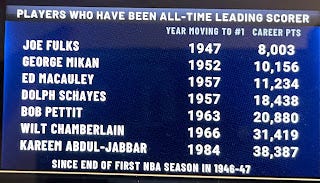
Chamberlain owned the record for almost as long as all of his predecessors combined, and Abdul-Jabbar stayed on top for a longer period than all of his predecessors combined. It will be interesting to see how big of a lead James builds, and how long he holds the record; there is a decent chance that many of us who watched James set the record will not live long enough to see James' record broken--if indeed it is ever broken.
James scored 23,119 points in his two stints with the Cleveland Cavaliers (2003-10, 2014-18), and he added 7,919 points in his four seasons with the Miami Heat (2010-14). After scoring 38 points versus the Thunder, he has scored 7,352 points in his five seasons with the L.A. Lakers (2018-23).
Before delving further into the historical context, it must be said that this game was a microcosm of the Lakers' season: James put on a scoring show, the Lakers did not offer much defensive resistance, and a squad with three future Hall of Famers--James, Russell Westbrook, and Anthony Davis--lost to a team that has spent recent seasons openly tanking but is improbably ahead of the Lakers in the standings, a circumstance that would be considered unacceptable for any other franchise featuring such a talented and accomplished trio. After breaking Abdul-Jabbar's record, James scored just two points the rest of the way, and in the closing moments of the game he was on the bench; he spoke about winning the game, but he was not on the court when Russell Westbrook led a fourth quarter rally that came up short.
Of course, this game--and this season, for that matter--are footnotes to the history James made. That being said, now that James is pro basketball's all-time leading scorer will the "experts" finally admit that James is not a "pass first" player? While it is true that James ranks fourth on the all-time career assists list behind only John Stockton, Jason Kidd, and Chris Paul--three players who are unquestionably "pass first" players--James is the most prolific scorer in pro basketball history, and he is the only player in pro basketball history to post 18 straight seasons averaging at least 25 ppg (he is on pace to accomplish that feat this season as well). James has ranked in the top five in scoring 13 times, including six third place finishes, three second place finishes, and winning the 2008 scoring title. Only Karl Malone (12) and Michael Jordan (11) had more 2000 point seasons than James (10). Durability is obviously essential for setting the career scoring record, but James did not set the record just by sticking around for a long time--his 27.22 ppg career scoring average ranks fifth on the ABA-NBA career list, trailing only Michael Jordan (30.12 ppg), Wilt Chamberlain (30.07 ppg), Elgin Baylor (27.36 ppg), and Kevin Durant (27.28 ppg).
It is worth noting that James ranks first in ABA-NBA career playoff scoring (7631 points, nearly 1700 points ahead of Michael Jordan), and sixth in ABA-NBA career playoff scoring average (28.69 ppg).
I am not sure why so many people are so insistent on calling James a "pass first" player. Perhaps this is because James thinks of himself that way and describes himself that way, so media members who crave access to him do not want to contradict him. Perhaps this is because media members believe that it is somehow more impressive to set the career scoring record while allegedly not having a scorer's mentality, with the implication being that James is so great that he set this record without even really trying; that notion is absurd, because James has been trying very hard to score throughout his career, and he has been trying even harder to score for at least the past two seasons when it became apparent that (1) the record is within reach and (2) the Lakers have no realistic chance to win, so there would be no serious criticism of James for averaging 30 ppg while his team loses.
To be clear, I don't blame James for being focused on scoring during his career; any objective review of my coverage of his career would conclude that I have sometimes criticized James for not being aggressive enough in key playoff situations, but I have not criticized him for scoring a lot. In fact, when James finally became aggressive in key playoff games with the Miami Heat I praised him for being a dominant scorer when his team needed him to do that.
LeBron James is a tremendous all-around player, but his best skill is being a volume scorer who is also efficient. There is nothing wrong with that, and there is nothing wrong with stating a simple, obvious truth. We know that James was coached from his earliest playing days to respect his less-talented teammates, to share the ball with them, and to keep them involved; it is admirable that he was coached that way, and that he accepted that coaching--but that does not change the reality that in the NBA he developed into a tremendous scorer.
I only saw Abdul-Jabbar's career from afar watching TV as a young fan, but I had the privilege of seeing James in person on many occasions--including two NBA Finals games--as a credentialed reporter. The first time that I saw LeBron James in person in a regular season game was November 29, 2003, when the Memphis Grizzlies defeated James' Cleveland Cavaliers. Rookie James, in his 17th career NBA regular season game, scored a team-high 33 points on 14-28 field goal shooting while also grabbing 16 rebounds, dishing for seven assists, and committing eight turnovers while logging 54 minutes. That was the first 30 point game of James' career. Pau Gasol scored a game-high 37 points for the Grizzlies.
I covered LeBron James' first playoff game, a 97-86 Cavaliers home win versus the Washington Wizards during which James produced 32 points, 11 rebounds, and 11 assists while playing all 48 minutes. I covered all three of Cleveland's home games in that series, culminating in Cleveland's 121-120 overtime win in game five as James poured in 45 points, which stood as his playoff career high until his legendary 48 point performance versus the Detroit Pistons in game five of the 2007 Eastern Conference Finals. The Cavaliers won game six in Washington to advance to the second round for the first time in James' career. I covered all three of Cleveland's home games versus Detroit in the second round. Cleveland lost game six at home by two points, and then lost game seven in Detroit.
In 2007, James led the Cavaliers to the franchise's first NBA Finals appearance, and I covered many of James' home games in the regular season, playoffs, and NBA Finals. James scored 25 points in his first home game in the NBA Finals, but he shot just 9-23 from the field and committed five turnovers as the San Antonio Spurs won 75-72 to take a 3-0 series lead. In game four, James led Cleveland with 30 points and 10 assists, but he shot 10-30 from the field and candidly admitted, "I have to be 10 times better."
It took a few years for James to understand what it takes to win championships, but he won four of them from 2012-2020, and he led each of his three teams--Cleveland, Miami, L.A.--to at least one title, which is remarkable considering how his career began: some of James' high school games were shown on national television, and he entered the NBA straight out of high school shouldering high expectations that might have destroyed a lesser person/lesser player, but he proved to be one of the few athletes who not only matches the hype but exceeds it. While there is no question that it is easier to score now in the NBA than it was in any other era, there is also no question that scoring as efficiently and productively as James has over such a long period of time is amazing. For over a decade, Chamberlain, Abdul-Jabbar, and Julius Erving were the only players in pro basketball history who had scored at least 30,000 career points. After Michael Jordan and Kobe Bryant broke down physically while still several thousand points shy of Abdul-Jabbar's record, it was reasonable to believe that no player would match Abdul-Jabbar's total--but James has not only accomplished this but he has a realistic shot at becoming the first pro basketball player to score 40,000 career regular season points.
LeBron James is not a "pass first" player, but he is an incredible scorer in addition to being a great all-around player.