
Mac McClung stole the show in the 2023 Slam Dunk Contest, and he defended his title in 2024, prevailing over a field including three-time NBA All-Star Jaylen Brown of the Boston Celtics, Miami Heat rookie Jaime Jaquez Jr., and fellow G-Leaguer Jacob Toppin (brother of Obi Toppin, who won the 2022 Slam Dunk Contest after finishing second to Anfernee Simons in 2021). McClung is the first repeat Slam Dunk Contest winner since Zach LaVine in 2015-16. Other repeat winners include Michael Jordan (1987-88), Jason Richardson (2002-03), and Nate Robinson (2009-10). Robinson is the only three-time champion (he also won in 2006), while Dominique Wilkins (1985, 1990) and Harold Miner (1993, 1995) each won two non-consecutive Slam Dunk titles.
McClung had not played in an NBA regular season game prior to last year's Slam Dunk Contest, and he has still only played in four NBA regular season games (none this season). It has been a long time since the Slam Dunk Contest consistently attracted All-Star players, and those days seemingly are gone forever; the top players either don't want to bother with the event, or else they fear that not winning would somehow hurt their endorsement portfolio. It is sad that the best players don't want to compete in the Slam Dunk Contest, but this is just symptomatic of the larger problems of load management, tanking, and a generally lax attitude toward competition (which has completely infected the All-Star Game itself, turning a once prestigious showcase into a pathetic farce).
I have mixed feelings about the Slam Dunk Contest. On the one hand, as a youngster I idolized the great dunkers and worked hard to try to be able to dunk on a regulation hoop (I failed). Any reasonably competent hooper can make a three point shot, but only a small percentage of humans can dunk on a regulation hoop; fans cannot match Stephen Curry shot for shot, but we can replicate the feeling of making a three pointer in a way that we cannot replicate the feeling of jumping three feet or more into the air and stuffing a basketball through the hoop. Thus, the slam dunk is the province of high level athletes and resides in a territory that most of us cannot visit. On the other hand, the sport's elite players have no interest in competing to see who is the best dunker, thus ceding the air above the rim to great leapers who are marginal professional hoopers.
I respect McClung for developing his hops, and for being a better basketball player than most people on Earth--but he is not an NBA player and I doubt that he would win a Slam Dunk Contest against a field of motivated NBA All-Stars.
So, as fans we can either complain about what the NBA will likely never give us, or we can accept what we get.
McClung is an entertaining dunker, although this year he did not quite reach the heights--literally and figuratively--that he did last year, a fact that he acknowledged during the trophy ceremony when he said that he wished he had given the fans a better show.
All of that being said, McClung beat the competitors in front of him, and that is all he can reasonably be expected to do. McClung clinched the title by jumping over Shaquille O'Neal, grabbing a basketball out of O'Neal's outstretched hands, and doing a two-handed reverse dunk.
Julius Erving--who won the 1976 ABA Slam Dunk Contest and was runner up (at age 34!) to Larry Nance in the 1984 NBA Slam Dunk Contest--presented the Julius "Dr. J" Erving Slam Dunk Contest trophy to McClung:
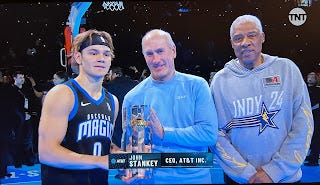
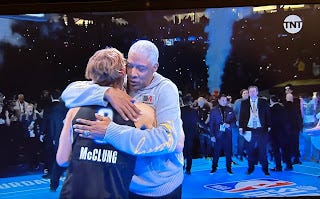
I will reiterate what I emphasized after last year's Slam Dunk Contest: Erving is the perfect choice for being the namesake for the NBA Slam Dunk Contest trophy, and it is great that the trophy clearly notes that Erving was much more than just an exciting dunker by including depictions of Erving's two NBA All-Star Game MVPs and his three ABA regular season MVPs (1974-76; he shared the 1975 award with George McGinnis), though it is puzzling that the trophy omits Erving's 1981 NBA regular season MVP. If the NBA ever creates a trophy honoring members of the 30,000 Point Club then Erving would be a great choice for that trophy as well, because he was the first "midsize" player to join a club that previously had been the exclusive province of two of the sport's greatest big men: Wilt Chamberlain and Kareem Abdul-Jabbar. Much like Erving paved the way for "midsize" players to win NBA regular season MVPs, he also paved the way for "midsize" players to crack the 30,000 point barrier that had previously eluded Pantheon players, including Elgin Baylor, Jerry West, and Oscar Robertson.
Young fans may scoff at what they consider to be pedestrian dunks in the early Slam Dunk Contests, but it is important to remember that Julius Erving, David Thompson, Larry Nance, Michael Jordan, and Dominique Wilkins were the pioneers: they laid the groundwork for what came next--and they were all at least All-Stars (Nance is the only non-Hall of Famer in that group), meaning that fans were treated to watching the best players competing against each other head to head.